
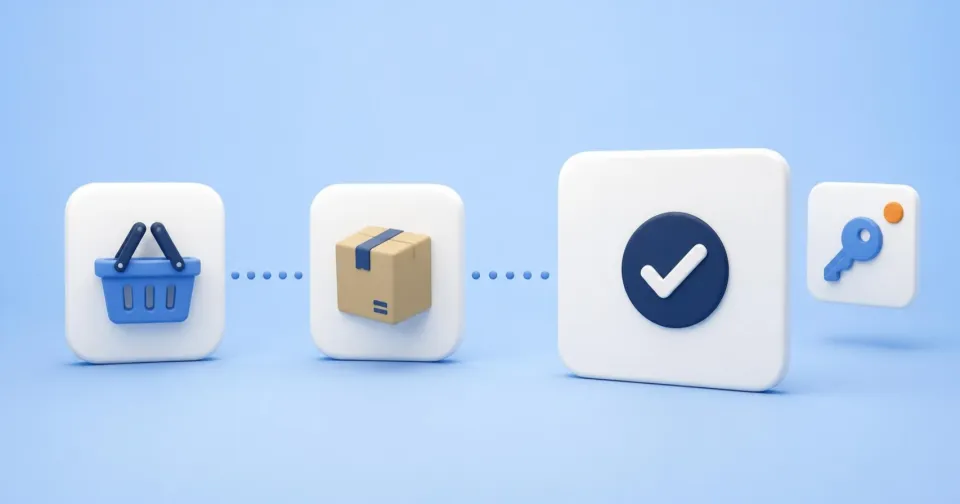
Registration helps sales when it is optional, arrives at a moment when nothing stands between the customer and a finished order, and promises one benefit the customer will actually notice on their next purchase. A mandatory account before checkout, by contrast, puts some people off, and according to European data protection authorities it is hard to justify for an ordinary one-off purchase. Beware the most common argument for registration, too: registered customers usually buy more, but that does not mean registration made them do so.
Mandatory registration costs orders
Baymard Institute regularly asks US online shoppers why they abandoned a purchase in progress. Leaving aside those who were “just browsing”, 19% cite the site wanting them to create an account. These are stated reasons from the US market, not a measured loss of orders at any particular store. Usability testing by Nielsen Norman Group points the same way: forced registration causes lost sales, and people resist it because it adds extra steps, they do not know whether they will return, and they worry about unwanted email and about how their data will be stored.
Shoptet, the leading Czech e-commerce platform, recommends the same in its glossary: a store should allow purchases without registration, ask only for the essential details and give the customer a choice. The practical default for a store owner is simple: a guest must get through checkout as easily as a registered customer.
The best moment is after the order
Where you offer registration matters as much as whether you offer it. In its benchmark of large online stores, Baymard found that 42% prompt customers to create an account before or during checkout. In usability testing, such prompts slowed people down and some took them to be mandatory. Offering the account on the order confirmation page worked better.
The reason is practical. By the end of checkout the customer has already entered their name, address and email, so an account means only choosing a password. Baymard adds two recommendations: mention briefly at the start of checkout that an account can be created at the end, so people do not go looking for it, and spell out on the confirmation page exactly what the account will give them.
On Shoptet, note that a customer who first ordered as a guest and registers later has to verify their email before earlier orders are linked to the account. It is worth saying so next to the offer; otherwise the new account looks empty.
The post-order offer must remain a genuine choice. The European Data Protection Board (EDPB) lists as deceptive practices, for example, an account the store has already created in the background that the customer merely confirms by setting a password via an email link, and it warns against using the last moment before payment to collect consent for other purposes.
One benefit the customer will actually feel
According to Baymard, “create an account for faster checkout” does not convince most people; the benefit needs to be concrete. A good benefit has two properties: the customer cannot get it without an account, and they will genuinely use it the next time they deal with the store. Typical examples:
- a faster next order with saved addresses, if your range lends itself to repeat purchases;
- an overview of orders and their status, useful for more expensive goods, warranties and complaints;
- a customer-group price list or discount, such as wholesale prices. In Shoptet a group can have its own price list, a maximum discount and, for wholesale, manual approval of members.
Choose the one that fits your range and write it in a single sentence. If you cannot find such a benefit, that is a useful finding: registration then adds nothing for the customer and there is no point pushing it.
A newsletter, on the other hand, is not a benefit. You do not need an account to send news: according to the Czech data protection authority (ÚOOÚ), a store may send its own customers marketing messages about similar goods without consent, provided they can easily opt out. If you collect consent anyway, it must be freely given and separate from the order.
Your store data in one place
Korzaro connects your store, customer and marketing data so you can decide on the full picture, not on a single number.
What data protection says
The General Data Protection Regulation (GDPR) requires a store to process only the data necessary for a given purpose, including by default. The Czech authority puts this in practical terms for online stores: collect only what is needed to identify, contact, deliver to and take payment from the customer.
In December 2025 the EDPB adopted recommendations on mandatory accounts in e-commerce, so far as a version for public consultation. They state that for a one-off purchase, requiring an account can rarely be justified by performance of the contract, legitimate interest or building loyalty. Subscriptions or access to exclusive offers may be exceptions. The EDPB regards a choice between guest checkout and a voluntary account as the most privacy-protective option. This is not the final text or legal advice for a specific store, but its direction matches what usability research recommends.
Why higher spending by registered customers proves nothing
The most common argument for pushing registration is that registered customers buy more often. In a store’s data this is usually true. Illustratively, with invented numbers: 40% of registered customers buy again within six months, compared with 15% of guests. That does not support the conclusion that “registration increases repeat purchases”.
Registration is voluntary, so it is chosen mainly by people who already expect to buy again: regular buyers, businesses, collectors. Statisticians call this a confounding variable – the intention to return drives both registration and the next purchase. Observational data can therefore usually show an association, not a cause.
This is not just a theoretical caveat. A study of Dutch supermarket loyalty programmes found that members spent a much larger share of their grocery budget with the chain, but once self-selection into the programme was taken into account, the real effect of membership was about seven times smaller than a simple comparison suggested. The sector and the tool are different, so do not transfer the size of the effect to an online store. The mechanism is the same.
Shoptet data holds one more trap: the Customers overview contains only registered customers; guests do not appear in it at all. Any comparison of “how many customers we have and how they buy” built on that overview describes only a slice. Guests have to be identified from orders, typically by email.
How to tell whether registration helps
Instead of comparing registered customers with guests, track what changes after you adjust checkout, always over a comparable period and the same season:
| Question | What to track | What to watch for |
|---|---|---|
| Does registration deter purchases? | Share of started checkouts that end in an order | Seasons, promotions and shipping changes show up too |
| Do people accept the account offer? | Share of new customers who create an account on the confirmation page | A high share does not by itself mean higher revenue |
| Do customers come back more often? | Share of new customers who buy again within a window matching your purchase cycle | The window must be complete for every period; a short one tells you nothing |
The most reliable answer comes from a test in which some customers see the new account offer or benefit and others do not, and you compare repeat purchases between the two groups. Where a test is not possible, treat a before-and-after comparison as an indication and record what else changed in the meantime.
What to do now
- Go through checkout as a new customer. Check that a guest can finish without an account and that nothing suggests an account is mandatory.
- Move the registration offer to the order confirmation page. At the start of checkout, simply mention that an account can be created at the end.
- Write one account benefit in a single sentence. If you cannot find one, do not push registration.
- Keep consent separate from the account. Do not bundle a newsletter or other consent with registration, and do not pre-tick it.
- Measure the impact on the right base. Track checkout completion and repeat purchases for all new customers, guests included, over comparable periods and with a long enough window.