
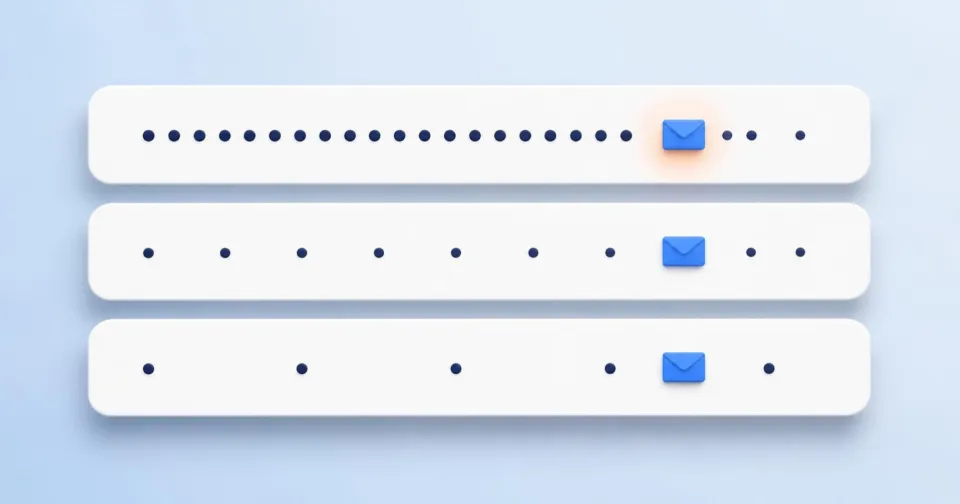
A repeat-purchase reminder is useful when it arrives at the moment a customer actually needs the product again or when a related item makes sense. That moment differs from customer to customer, so one number for the whole store cannot set it. Every message also has a cost: some people unsubscribe, and the chance to reach them next time disappears with them. Decide three things together – timing based on real buying rhythm, a cap on contacts, and how you will know the reminder produced a purchase that would not have happened anyway.
A customer's rhythm matters more than the store average
A reminder makes sense for consumables, for products with a natural follow-on (refills, accessories, the next item in a series) and for assortments where customers demonstrably return at similar intervals. Where the data show no such rhythm, a reminder has nothing to anchor to and can only push.
The store-wide average interval is not enough, though. The models marketers use to estimate whether a customer is still active work with the number and timing of each person's purchases separately. The same framework can be calculated without specialist software, so it is not reserved for large retailers. For reminders this gives a simple rule: what matters is the gap between a given customer's purchases and how long it has been since their last one.
An illustration with invented numbers: two customers buy the same coffee. One orders roughly every five weeks, the other every ten. A reminder set for day 35 for everyone reaches the first on time and the second halfway through the bag. The second learns to ignore it or unsubscribes. For a customer with only one previous purchase you do not yet know their individual rhythm; starting from the typical interval for the category and waiting for more data is sensible.
Too early can be worse than not at all
Intuition says that an earlier reminder is better. Field experiments with abandoned-cart reminders at a large online retailer showed the opposite. Customers who received a reminder by email or in the app within an hour of abandoning the cart bought less than a control group that received none. A reminder one to three days later had a positive effect, and a second experiment replicated the result by SMS.
An abandoned cart is not a replenishment, and the figures should not be carried over. The study does establish an important point: timing changes not only the size of the effect but potentially its sign. Send a replenishment reminder when the customer is approaching their next purchase according to their own rhythm, not days after delivery.
Every extra message has a cost
The strongest evidence of email fatigue comes from a randomised experiment at a large North American online retailer with more than 600,000 customers. Half received coupon emails daily, the other half every other day. The less frequent schedule cut unsubscribes over the week by 59%, but also reduced short-term revenue and purchase rate by 5–8%. Using historical data, the authors also estimated that unsubscribing is associated with a 36% fall in a customer's monthly spending. An earlier study of an email marketing programme reached a related conclusion: marketing intensity affects how long a customer stays subscribed.
Both come from North America, and the first is a working paper that has not yet been peer reviewed. Neither gives the right frequency for a Czech store. They do show a trade-off that never appears in a campaign report: one more message adds revenue this week and removes customers you will not be able to reach next time.
Deliverability is the second hidden cost. Since 2024 Gmail has required senders of more than 5,000 messages a day to offer one-click unsubscribe and to process it within two days. The share of messages marked as spam should stay below 0.1% and never reach 0.3%; Yahoo sets the same upper limit. Reminders that people experience as nagging can therefore harm delivery of transactional and other messages too.
In practice:
- One cap for all contact with a customer. Newsletters, replenishment reminders and other automations count together. Set the number from your own data and verify it with a test; there is no universal figure.
- Stop the reminder after a purchase. Reminding someone about a product they have just ordered is the purest form of noise.
- Customers who stop responding get less, not more. Increasing pressure on people who neither open nor buy raises the risk of complaints.
A discount is not the default content
If every reminder carries a discount, customers learn to wait for it. Long-term panel research found that frequent promotions make consumers more sensitive to price and promotions. The data are older and cover one packaged-goods category, but the mechanism is general. A reminder can offer a different reason: how long the product usually lasts, what complements the previous purchase, what is back in stock, or a one-click reorder.
When your customers come back
See the typical time to the next purchase, customer groups and email automation results in one place.
Who you may contact without consent
Under Czech law, commercial communications sent electronically generally require consent. Act No. 480/2004 Coll. contains an exception: contact details obtained from a customer in connection with a sale may be used for messages about your own similar products or services. The customer must have a clear, simple and free way to refuse, both when the details are collected and in every subsequent message. Each message must be clearly marked as commercial, must not hide the sender and must include a valid address for opting out.
The Czech Office for Personal Data Protection (ÚOOÚ) clarifies several points that apply directly to reminders:
- A customer is someone who has concluded a contract with you, paid or free. A prospective customer or a competition entrant is not.
- Similar products: a store that expands a narrow range into completely different goods needs consent to promote them. With a broad range, customers can expect offers across the whole assortment. The office considers letting customers choose the categories they want to be good practice.
- Refusal at collection can be offered, for example, with a checkbox saying “I do not wish to receive commercial communications”.
- Third-party offers are not covered by the exception and need separate consent.
- A list of refused contacts must be kept and checked against every send. Using an email provider does not remove your responsibility.
- Fines for a legal entity can reach CZK 10 million.
The rules apply to SMS as well. The EU directive behind the Czech law treats SMS as electronic mail, and the office recommends letting SMS recipients opt out by replying with a word such as “STOP”. The GDPR accepts direct marketing as a legitimate interest, but an objection to it must always be honoured and the data may no longer be used for marketing. An unsubscribe is therefore final: a customer who has opted out can be contacted again only with new consent.
This section is orientation, not legal advice for a specific send.
How to tell whether a reminder really helps
An email tool usually credits a reminder with every order that follows it within a given window. A repeat customer would have placed some of those orders without it – that is what makes them a repeat customer. Credited revenue therefore tends to overstate the effect.
A control group is more reliable: a randomly chosen minority of customers who would have received the reminder do not get it. After the same window you compare the share of buyers, revenue and margin in both groups, along with unsubscribes and complaints. The difference is the increment the reminder actually caused.
Expect this measurement to be noisy. Large online advertising experiments at major US retailers showed that individual purchases vary so much that reliable results need large samples, and that observational methods without random assignment are distorted by how target customers are selected. In a smaller store, let the test run longer and do not read it after the first week.
A control group also shows whom to send the reminder to. Research on retention campaigns found that the best targets are not the customers at highest risk of leaving but those on whom the intervention demonstrably works. When the data allow, compare the difference against the control group separately for loyal and less frequent customers instead of extending the reminder to everyone.
| What the control-group comparison shows | What it means | Sensible next step |
|---|---|---|
| More purchases and margin, unsubscribes roughly unchanged | The reminder adds value | Keep it and test a different timing |
| More purchases, but clearly more unsubscribes | Short-term gain at the cost of contacts | Reduce frequency or narrow the audience |
| Purchases the same as the control group | The reminder only accompanies purchases that would happen anyway | Change the content or timing, or switch it off |
| Results fluctuate, groups are small | You do not know yet | Extend the test; do not decide on credited revenue |
What to do now
- Pick one repeatedly purchased category. Only where the data show that customers genuinely return.
- Calculate the gap between purchases for individual customers. Tie the reminder to their own rhythm; for customers with one purchase, to the category's typical interval.
- Set a shared contact cap across newsletters and automations, and stop the reminder after a purchase.
- Check the legal basis. Who is a genuine customer, whether the offer is your own similar product, whether every message – including SMS – has an opt-out, and whether refused contacts are removed before each send.
- Leave a random tenth of recipients without the reminder and, once the window has closed, compare purchases, margin, unsubscribes and complaints.
In its Customers section, Korzaro uses order history to show the median time to a second purchase, quarterly cohorts and a split of customers into loyal, returning, new and one-off. The Mailing section shows newsletters and running automations from the connected email tool, with the revenue the tool credited to them. Korzaro sends nothing and does not present credited revenue as an increment; only your control group can show that.